Équateur
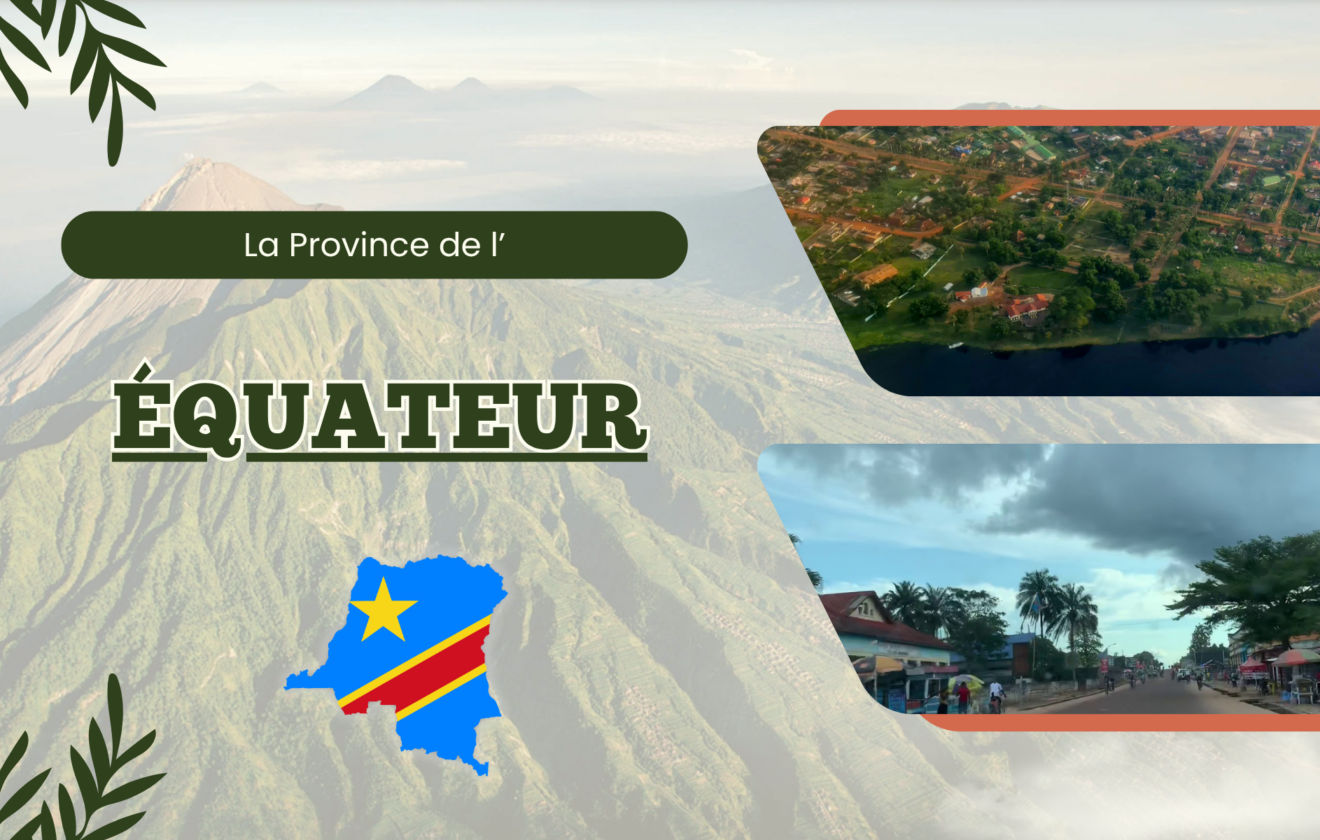
Provincial Geography & History
Equateur Province:
Rivers, forests of the Congo Basin, and the memory of a pivotal territory
In the northwest of the DRC, Équateur is a province of rivers and forests, a place whose history is written as much by
waterways as by colonial memory, postcolonial dynamics, and the daily struggle to connect dispersed communities.
This article offers a Congolese perspective : geography, administration, societies, economy, challenges, and paths to transformation.
By the editors of CongoHeritage.org · Congolese perspective
Ecuador, the memory province of the Congo Basin
When a Congolese says “Equator”, he is not just talking about a province: he is evoking an imaginary world .
That of the great waters of the Congo River, of the tributaries that meander through the forest, of the canoes and barges,
of the markets where smoked fish and cassava circulate, of the river cities like Mbandaka (formerly Coquilhatville),
and of this feeling that, in the Northwest, the State often arrives by river… and sometimes leaves with the river.
Ecuador is also a territory steeped in historical memory : the memory of colonization and the extractive economy,
the memory of concessions, rubber, and requisitions, but also the memory of resistance, administrative reconfigurations
, and postcolonial debates on the Northwest’s place within the Congolese state.
From a Congolese perspective, the challenge is not simply to recount “what happened”: it is to understand
how a riverine and forested region can become a province fully served by modern institutions.
This article adopts a CongoHeritage style: clear, structured, and grounded in reality.
It will discuss administration, geography, peoples, the economy, biodiversity, and challenges, with a central theme:
how to transform natural wealth into social dignity , instead of allowing wealth to become a source of predation.
Administrative landmarks and provincial identity
A reconfigured province (2015 division)
Historically, “Équateur” referred to a vast administrative region in northwestern Congo.
With the territorial reform that accompanied the creation of new provinces, the former greater Équateur was “broken down”
to bring the administration closer to the citizens. Today, the province of Équateur coexists with “sister” provinces
from the same historical area (such as Mongala , Nord-Ubangi , Sud-Ubangi , and Tshuapa ).
This reconfiguration has a concrete consequence: a smaller province can be more governable,
but only if it receives the budgetary, human, and infrastructural resources necessary to run its institutions.
Otherwise, the map is changed without changing life.
Provincial capital: Mbandaka
Mbandaka , a river city and logistics hub, is at the heart of the provincial identity.
It is a gateway to the forest, a passage point between riverside villages and national economic circuits,
and a place where administrative, educational and health services are concentrated.
But a provincial capital is not enough: the question in Ecuador is one of reach .
How do provincial services reach remote areas? At what cost? How regularly?
This is where governance becomes a problem of transport, data, and presence.
Quick overview: what defines Ecuador today
- Location : Northwest of the DRC, in the Congo Basin.
- Identity : river province (Congo + tributaries), heavily forested.
- Major urban center : Mbandaka (capital).
- Typical economy : subsistence farming, fishing, river trade, forest products.
- Key challenge : connecting dispersed communities and securing resource governance.
Table: The “historical” Ecuador and the “current” Ecuador (administrative reading)
| Period | Ladder | Logic | Effect on citizens |
|---|---|---|---|
| Before 2015 | Greater Ecuador (larger administrative area) | Provincial centralization, significant distances | Remote services, difficult logistics |
| Since 2015 | Ecuador + provinces originating from the same historical area | Proximity to administrative offices desired | Potential for local governance if real resources are available. |
Note from CongoHeritage: territorial reform only “succeeds” if it is accompanied by budgets, cadres and infrastructure.
Location, topography, hydrography and climate
The province of Équateur lies at the heart of the Congo Basin , one of the world’s largest tropical rainforests.
Here, geography is not merely a backdrop; it governs social life. Distances are vast, roads are often expensive to maintain,
and water remains a vital artery of transportation. The terrain is generally low to moderately rolling, with extensive wetlands, marshy areas
, and dense forests where access is seasonal.
Hydrography: the province is a “network”
Ecuador’s identity is defined by the Congo River and its tributaries.
Rivers structure markets, trade routes, seasonal migrations, and even access to public services.
In some areas, traveling by dugout canoe or barge is more practical than traveling by road.
This dependence on the river network creates opportunities (transport, fishing) but also vulnerabilities (isolation if logistics break down).
An “Ecuadorian” development reading must therefore integrate water as infrastructure:
river ports, navigation safety, warehouses, cold chain for fish, and links with Mbandaka.
Climate: humidity, seasons and public health
Ecuador has a generally equatorial climate , humid and hot, with seasonal variations that affect fishing,
agriculture, road conditions, and health (malaria, waterborne diseases, etc.).
The rainy season makes some areas very difficult to access, complicating the supply of health centers and schooling.
For communities, the season is not an abstract calendar: it is a logistical constraint.
And in a province where the state is sometimes “far away”, anticipation (stocks, medicines, seeds) becomes a public policy in its own right.
Table: Functional reading of geography
| Element | What this produces | Risk | Intelligent answer |
|---|---|---|---|
| Congo River + tributaries | Mobility, river trade, fishing | Isolation if ports and barges are lacking | Ports, warehouses, navigation safety |
| Dense forest | Forest resources, biodiversity, climate | Deforestation, poaching | Community management + control |
| Seasons/Rain | Agricultural and river calendar | Impassable roads, disruptions in care | Inventory, pre-positioning, mobile health |
Peoples, languages and social life: a province of plurality
Ecuador is a space of cultural plurality, where identity is constructed through family, village, river, and city.
Community solidarity plays a major role, particularly where the state is absent or irregular.
Languages, rituals, marriages, markets, and churches form a social structure that maintains the community fabric.
From a Congolese perspective, speaking of “ethnic groups” only makes sense if one also explains how these identities are mobilized: for cohesion, mediation… or sometimes political competition.
Languages: French, Lingala and local languages
French structures the administration and the school system. Lingala , widely spoken in the Northwest, facilitates communication beyond the villages, particularly around the river, in markets, and through radio broadcasts. Alongside these languages, local languages remain central to identity and cultural transmission. The educational challenge is not to choose one language over another, but to organize a learning process that equips young people with proficiency in academic French while simultaneously valuing community languages as a living heritage.
City and village: two worlds that echo each other
In Equateur Province, the city doesn’t erase the village; it extends it.
Many families live between the two, following the seasons, economic opportunities, schooling, or healthcare.
Mbandaka, for example, acts as a service center but remains dependent on products from the hinterland (fish, cassava, fruit, timber).
This relationship leads to a simple conclusion: without reliable river and road networks, the urban economy weakens and the village retreats.
▸Accordion: social cohesion and the risks of identity politicization
Local identities can strengthen solidarity (mutual aid, mediation, funeral assistance, support for schools).
But in times of political competition, they can also be exploited, especially if access to public office is seen as a “prize”.
Mature provincial governance protects plurality: transparency in appointments, equitable access to services, and a justice system capable of arbitrating conflicts without favoritism.
History: From the Congo “by water” to colonial memory
In Ecuador, history is written in the rivers. Before colonization, waterways structured trade, migration, and alliances.
Belgian colonization transformed these routes into axes of administration, resource collection, and extraction: posts, missions, river stations, and control networks.
For the Congolese, this history is not merely administrative; it is social. It touches upon the land, labor, the body, and dignity.
Ecuador’s colonial memory is deeply intertwined with the extractive economy: rubber, ivory, collection, taxes, and bonds.
In many families, this memory survives as fragmented narratives, sometimes unspoken, sometimes passed down as warnings.
Colonial violence was not uniform everywhere, but the underlying logic remained the same: to achieve production at the lowest possible cost, using a coercive apparatus capable of breaking resistance.
Where the administration sought to be “civilizing,” Congolese people often retained the racial hierarchy, fear, and punishments.
After 1960, Ecuador, like the rest of the country, entered the turbulent postcolonial period: instability, restructuring, and centralization.
But one fact remained: the river economy remained the backbone of the economy, and the state, to maintain its presence, had to control logistics and services.
From a Congolese perspective, much of the frustration stems from a simple feeling: Ecuador produces (fish, timber, agriculture), but receives too little in return (roads, schools, healthcare).
Boxed text: Why colonial memory remains “active”
In Ecuador, colonization is not just a chapter: it continues to influence debates on roads, resources, logging concessions,
center-periphery relations, and historical justice. When a province sees its wealth disappear without proportional public services, the memory of “taking without giving back” is reactivated.
Economy: agriculture, fishing, timber and river trade
Ecuador’s economy is, above all, a subsistence economy : subsistence farming, fishing, small businesses, crafts, and river transport.
This does not mean a “small economy”; it means a very broad-based economy that sustains the majority of families.
The province also possesses significant forest resources, creating a constant tension between development and conservation.
From a Congolese perspective, the economic challenge is clear: to move from a subsistence economy based on raw exports to one that generates local value .
Agriculture: feeding the province, connecting the market
The agricultural base relies on food crops (cassava, maize, plantains, and locally grown rice, depending on the area), supplemented by cash crops according to distribution channels and seasons.
The problem is not only production: it also involves logistics (roads/tracks), storage (post-harvest), processing (flour, oil, drying),
and the ability to stabilize prices.
A realistic provincial strategy would be to secure “corridors”: linking production areas to river ports and Mbandaka,
then linking Mbandaka to national markets.
Fishing and river economy: edible gold
Fishing is a major resource, often underestimated in national policies.
It feeds cities and generates a chain economy: fishermen, smokers/dryers, transporters, vendors, and restaurateurs.
However, the lack of a cold chain, post-harvest losses, and the absence of modern port infrastructure reduce the value captured locally.
Protecting breeding areas, regulating destructive nets, and improving logistics (coolers, warehouses, secure boats) can transform fishing into a sustainable provincial engine.
Table: Economic sectors and bottlenecks
| Sector | Asset | Neck | Priority lever |
|---|---|---|---|
| Agriculture | Soil, know-how, urban demand | Roads/tracks, storage, processing | Collection centers + rural tracks |
| Fishing | River, lakes, high consumption | Cold chain, losses, river safety | Port + cold + regulations |
| Timber / forest products | Abundant resource, markets | Traceability, illegality, deforestation | Transparency + local value |
| River trade | Natural transport network | Outdated ports, security, costs | Port modernization |
▸Accordion: forest economy — extraction or local value?
Timber can either enrich a province or deplete it. It all depends on the supply chain: if we cut down, export, and leave the province without schools, it’s a loss.
If we manage the forestry sector, process it locally (carpentry, panels, briquettes, non-timber forest products), create jobs, and fund services.
The condition is simple: transparency in concessions, real control, and community participation. Without this, the forest becomes an “ownerless treasure”.
Environment: forests, peat bogs, lakes and biodiversity
Ecuador is one of the major forested provinces of the Congo, at the heart of global climate dynamics.
The forests of the Congo Basin store carbon, regulate rainfall, and harbor remarkable biodiversity.
In certain areas of the central basin, peatlands (water-saturated organic soils) represent a major climate challenge: they store significant amounts of carbon
but become fragile if the environment is drained or degraded.
For Ecuador, the environment is therefore not an “NGO issue”: it is a strategic asset for the Congo’s future.
Lakes and wetlands: food and vulnerability
Wetlands (lakes, marshes, floodplains) support fishing, seasonal agriculture, and trade.
They are also reservoirs of biodiversity. But they are vulnerable: overexploitation, pollution, population pressure around certain sites,
and conflicts over land use. Protecting wetlands means protecting food.
Conservation: protect without excluding
Conservation policies fail when they humiliate communities. The most sustainable approach is co-managed
conservation : communities + state + science. This makes it possible to combat poaching, preserve sensitive areas, and create a local economy (responsible ecotourism, monitoring jobs, sustainable supply chains).
Congolese lesson: the forest should not be a “monument”, but a living economy
A forest province doesn’t develop by prohibiting everything, nor by allowing everything.
It develops by creating simple, applicable rules and by making the forest an asset that funds healthcare, education, and local employment.
Conservation then becomes a social contract, not a top-down directive.
Contemporary challenges: roads, health, governance
Ecuador faces typical challenges of a vast and humid province: transportation is expensive, roads deteriorate quickly,
maintenance is inconsistent, and logistics are heavily dependent on the seasons.
When transportation is poor, healthcare and education suffer. This connection is stark: a health center without medicine is not a health center.
A school without teachers is an empty promise. Citizens experience this firsthand, not just read about it.
The other challenge is governance: taxation, transparency, combating harassment, and securing markets and waterways.
In a river-based economy, illegal “small taxes” can become a giant tax on poverty.
The result is simple: prices rise, trade slows, families retreat, and the province fragments.
Governance, here, is measured by the market basket.
Table: Major challenges and realistic responses (provincial level)
| Challenge | What citizens are experiencing | Possible provincial response |
|---|---|---|
| Transportation | Seasonal isolation, high prices | Ports, targeted maintenance, priority corridors |
| Health | Drug shortages, difficult evacuations | Pre-positioning, mobile clinics, data |
| Governance | Hassles, low trust | Transparency, one-stop shop, sanctions |
| Environment | Loss of resources, conflicts of use | Co-management, local monitoring, sustainable economy |
Simple rule: if it doesn’t circulate, nothing works
In Ecuador, the primary public policy is circulation : ships, ports, runways, warehouses, communications.
When goods circulate, schools fill up, medicines arrive, legal taxes replace red tape, and the State becomes visible.
Congolese Perspectives: A Realistic Roadmap for Ecuador
A realistic roadmap for Ecuador doesn’t begin with grandiose promises.
It begins with choices: which river routes to prioritize, which ports to modernize, which roads to maintain, which health centers to secure,
which schools to strengthen, and how to make public revenues visible through tangible results.
In other words: moving from a “proclaimed” state to a “felt” state.
Economically, the province would benefit from investing in short but structuring supply chains:
collection centers for agriculture, logistics for fishing, artisanal training and local wood processing,
and a reduction in red tape that stifles profitability.
Socially, it is essential to invest in education and healthcare with a focus on community engagement: training local teachers,
ensuring access to basic healthcare, and utilizing radio as a civic partner (information, prevention, education).
Finally, on a symbolic level, Ecuador must confront its past: its colonial past, its administrative transformations, and
its extractive economies. The goal is not to dwell on the past, but to learn a lesson:
a province is protected by its institutions . And these institutions are built on transparency, ethics, and access to public services.
Contribute to the “Ecuador Province” dossier
Do you have maps, local data (roads, ports, health, schools), family archives, photos or testimonies about Mbandaka and the surrounding territories?
Help CongoHeritage enrich this dossier with verifiable sources and respectful remembrance.
Suggest a correction or add a resource
Or explore: all CongoHeritage categories
Bibliography and resources
▸Working bibliography (to be expanded)
| Author / Source | Title / Link | Kind | Noticed |
|---|---|---|---|
| CongoHeritage.org | All categories CongoHeritage | Platform | Linking Ecuador to files on the Belgian Congo, decolonization, the provinces and the environment. |
| Academic work (to be added) | History of Coquilhatville/Mbandaka, concessions, river economy, Congo basin | Works / articles | Add university sources and local archives (DRC/Belgium/UN). |
| Environmental reports (to be added) | Forests of the Congo Basin, peat bogs, wetlands | Reports | Sources to support biodiversity, climate, community conservation. |
CongoHeritage Council
For an even more robust article, please help us find: (1) recent official provincial statistics, (2) maps of waterways/ports/tracks,
(3) historical studies on Mbandaka/Coquilhatville and the colonial economy, (4) environmental sources on the Congo Basin.

Congo Heriatge
CongoHeritage.org est une plateforme de savoir indépendante dédiée à la documentation de l’histoire, de la culture, de la politique, de l’environnement et des réalités contemporaines de la République démocratique du Congo. Ses articles et publications sont le fruit des contributions d’une communauté diverse de chercheurs, de journalistes, de praticiens et de voix communautaires venus du Congo et de la diaspora. L’ensemble des contenus soumis est évalué pour sa crédibilité, sa cohérence et sa conformité à la mission du site, qui est de promouvoir une information exacte, responsable et rigoureusement sourcée. En offrant des analyses et des ressources accessibles dans plusieurs disciplines, CongoHeritage.org vise à informer un public mondial, à soutenir les chercheurs et les étudiants, et à amplifier les perspectives congolaises sur les enjeux qui façonnent le passé, le présent et l’avenir de la nation.